
Council of Heads of Australasian Herbaria
Australian National Herbarium
Biographical Notes

|
|
Council of Heads of Australasian Herbaria | |
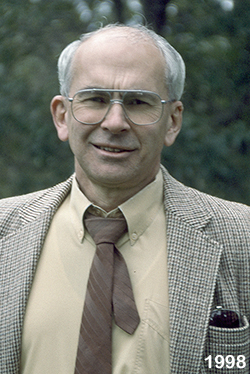 Ingwersen, Francis (Frank) (1942 - )
Born in Kerang Victoria 13 November 1942;
Early education was in Warrnambool Victoria and later in secondary college in Melbourne before completing a BSc majoring in Botany and Genetics with a minor in zoology, at the University of Melbourne.
During the undergraduate years he found professionally relevant employment during university vacations in organisations including ICI Agricultural (now Orica) at Croydon, Forestry School at Melbourne University's Mt Disappointment forest and spent a part time year as a botanical worker with the Department of Fisheries and Wildlife, conducting a survey of the artificial Lake Serendip near Avalon.
In the summers of 1965-6 and 1966-7 he was part of the Canberra Botanic Gardens (now Aust. National Botanic Gardens) stocktake and general herbarium work teams as a seasonal worker as a 'Gardener Grade 1'. However, the botanist-in-charge, Dr Betty Phillips also provided other work and in each of those seasons, he and another staff member, travelled to collect plants in remote areas: the Grampians Range in Victoria and the Little Desert near Horsham; the south coast of NSW and Eastern coast of Victoria and the Lower Snowy River Valley and Victorian Highlands with the then recently appointed associate botanist, Elizabeth Caroll (later E. Hayden).
On graduating he took a position in Darwin in January 1967, as a Botanist Class 1 within the Commonwealth Department of Territories in the Animal Industry and Agriculture Branch, Land Resources Section.
Mapping vegetation formed a major part of this work. A vegetation map based on aerial photo interpretation and the field work analyses was produced for the then, Munmalary buffalo station in the Alligator Rivers region, an area now within Kakadu National Park.
In 1969 he was appointed as a Botanist class 2, in the Department of the Interior in Canberra, soon changed to the Department of the Australian Capital Territory, and much later, with the coming of self-government in the ACT in 1988, this position became a local government one and he was in fact a founding member of the ACT Parks and Conservation service. The Canberra position was initially as a botanist (later it was more recognised as a vegetation ecologist).
Following a large fire in 1973, he began detailed research into the specific strategies the flora of the area used to regenerate. He was accepted by Prof. Lindsay Pryor as an MSc scholar and this work was completed in 1977 as his MSc Thesis under the supervision of Dr John Carnahan.
During these years he was a regular guest lecturer at the then, Canberra College of Advance Education, (now University of Canberra). Similar outreach involved lectures at Duntroon and the Canberra Institute of TAFE.
He became involved in studying the relationship between environment and Aboriginal occupation through researchers in the ACT and successfully established three archaeological surveys under the then National Estate Grants program in the Jervis Bay, Gudgenby and Gungahlin areas.
A survey of Black Mountain Nature Reserve was also made and vascular and non-vascular species were used in the data sets to attempt to detect small habitat variation across the reserve. Jan Ward (BSc U.Qld), an assistant to the botanist's position for many years, undertook much of the field work which was enhanced by her special interest in mosses, liverworts and lichens. Jan was the mainstay of work to maintain an independent herbarium of reference specimens within the ACT organisation.
He retired from full time government work in 2001 and completed PhD at ANU with a thesis '"Sundry nameless ranges" : the landscape ecology of the Naas-Gudgenby catchment', and moved into consultancies in the ACT and the ski-field areas of Kosciuszko National Park.
Following the devasting fires of 2003, he undertook monitoring of vegetation regeneration in study sites he had earlier set up when serving as a member of the Australian Alps Liaison Committee (now Australian Alps National Parks).
In retirement he continued involvement with the ACT and the southeast region of NSW through membership of the ACT Scientific Committee and the NPWS Southern Ranges Regional Advisory Committee.
A longer and more detailed Frank Ingwersen biography, in PDF format, is availale: LINK.
Source: Extracted from:
The Argus (Melbourne), Wed 18 Nov, 1942, p.2, Family Notices - INGWERSEN.
https://openresearch-repository.anu.edu.au/items/daaf0ff7-ac8d-4c2f-9a4c-7b708b7ab357
Frank Ingwersen, pers.comm, email to M.Fagg, 19/12/2025
Portrait Photo: 1998, M.Fagg, ANBG Photo Collection, H-511.
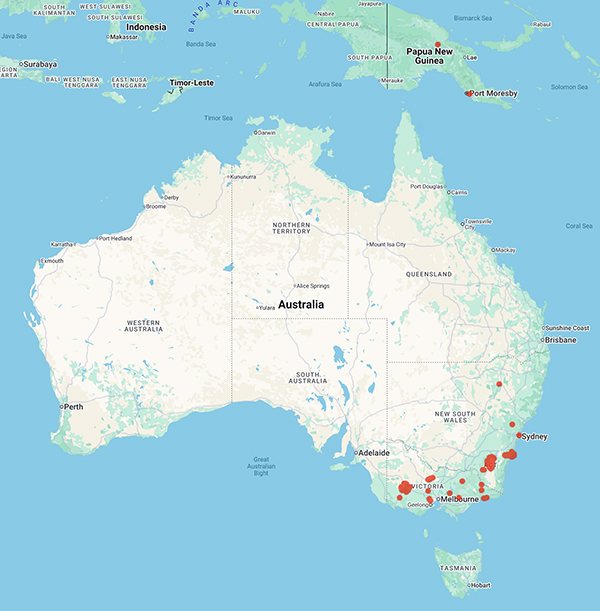
Data from 1,300 specimens